Retinitis Pigmentosa: Living Well with Low Vision
If you or someone you love has been diagnosed with retinitis pigmentosa, you are probably carrying a lot right now. There may be questions about what comes next, what you might have to give up, and whether independence is still possible. Take a breath. The honest answer is that most people with RP keep reading, working, raising families, and living full lives—with the right tools and a plan that stays a step ahead of the changes.
Retinitis pigmentosa (RP) is a group of inherited retinal conditions that cause gradual vision loss. Unlike macular degeneration, which affects central vision first, RP usually starts at the edges—night vision and peripheral (side) vision—before central vision is involved. Because RP often begins in your teens or twenties, you may have decades of slow change ahead, which is exactly why planning matters so much.
This guide walks through the full picture: understanding what RP is, what to expect at each stage, and the practical tools and strategies that help you stay independent. You do not need to absorb all of it today. Think of this as a map you can return to as your needs change.
Understanding Retinitis Pigmentosa
Retinitis pigmentosa is caused by genetic mutations that slowly damage the light-sensing cells in your retina, called photoreceptors. There are two kinds of these cells: rods and cones.
Rods handle vision in dim light and around the edges of your sight. In most types of RP, rods are affected first—which is why night blindness and shrinking peripheral vision tend to come early. Cones handle central vision, fine detail, and color, and they are usually affected later, if at all.
The pattern of change is fairly consistent: trouble seeing at night, then a gradual narrowing of side vision (often called tunnel vision), and sometimes changes to central vision in later stages. What is not consistent is the timeline. Some people notice slow changes over many decades. Others progress more quickly. Your specific genetic type plays a large role here, which is one reason genetic testing can be so useful.
RP is inherited in a few different patterns—autosomal dominant, autosomal recessive, and X-linked—and the pattern influences how quickly the condition tends to progress. It can also affect whether other family members carry the gene. A genetic counselor can help you make sense of what your results mean for you and for relatives.
Knowing your type helps you and your care team plan ahead instead of reacting to each new change. It can also tell you whether you might qualify for clinical trials. Research into RP is genuinely active right now—gene therapy, retinal implants, and other treatments are moving forward, and one gene-therapy treatment is already approved for a specific form of inherited retinal disease.
If you want a closer look at how the condition unfolds, our guide to retinitis pigmentosa symptoms and progression breaks down each stage and what you can do at each one.
Night Blindness: The First Challenge
For most people with RP, difficulty seeing in low light is the first noticeable symptom—and often the most disruptive to everyday life. It can take much longer for your eyes to adjust when you move from a bright room into a dark one, and dim settings that feel fine to others can feel nearly impossible to navigate.
This shows up in ordinary places. Dim restaurants, movie theaters, evening events, and walking outside after dark all become harder. None of that means giving up the things you enjoy—it means going in with a few strategies.
Good lighting at home makes an immediate difference, and carrying a small flashlight or using your phone’s light removes a lot of friction in restaurants and theaters. Letting the people you are with know what helps takes the pressure off and usually makes the whole evening easier.
Driving at night is often the hardest conversation. Many people with RP reach a point where night driving is no longer safe, and that decision deserves honesty and care rather than guilt. Our guide to managing night blindness with RP covers home, social, and outdoor strategies in detail, and our complete guide to driving with low vision walks through the driving question specifically.
Managing Peripheral Vision Loss
As RP progresses, your field of vision gradually narrows. Picture looking through a tube that slowly gets smaller over time—that is what “tunnel vision” describes. Your central vision may stay sharp, but you see less and less of what is around you.
This affects more than you might expect. Bumping into objects or people at your sides, missing steps or curbs, and feeling uneasy in crowded or unfamiliar places are all common as peripheral vision shrinks.
Scanning techniques help a great deal. Instead of relying on side vision to catch movement, you learn to deliberately turn your head and eyes to sweep an area—a skill that becomes second nature with practice. An orientation and mobility specialist can teach these techniques and tailor them to your daily routines.
This is also the stage where many people first consider a white cane, often well before they think of themselves as “blind.” Starting early, while you still have usable vision, makes learning easier and the transition smoother. Our guide to white canes and mobility aids for progressive vision loss covers when and how to begin.
Assistive Technology for RP
The right technology can keep you reading, working, and navigating independently at every stage of RP. The key is to explore tools before you urgently need them, so they feel familiar when the moment comes. Here is how the main categories fit together.
Magnification and Reading Tools
As long as you have usable central vision, magnification helps you keep reading comfortably. Electronic magnifiers enlarge text on a screen with adjustable size and contrast, and screen-magnification software does the same on your computer.
One detail matters for RP specifically: very high magnification can shrink how much you see at once, which can be tricky with a narrowed field. A low vision specialist can help you find the balance between large-enough text and a wide-enough view.
Wearable Technology
Wearable devices have advanced quickly and can be especially helpful for RP. Smart glasses like OrCam and Envision read text aloud, recognize faces, and identify products through a small camera. Services like Aira connect you to a live person who can describe your surroundings or guide you in real time.
- OrCam MyEye: A small camera that clips to your glasses and reads text aloud, recognizes faces, and identifies products.
- Envision Glasses: Similar AI-powered reading and scene description on a wearable platform.
- eSight Go: Headset that enhance and magnify your remaining vision, best suited to people who still have some central vision.
- Luna Glass: Developed for those who are night blind due to conditions like RP, to see again in dark and dimly lit conditions.
These tools each serve different needs and price points. Our guide to the best assistive devices for retinitis pigmentosa and our deeper comparison of wearable technology for RP walk through which options fit which stage.
Smartphone and Computer Accessibility
Some of the most powerful tools are already in your pocket. Built-in screen readers like VoiceOver (iPhone) and TalkBack (Android) read your screen aloud, and magnification and high-contrast settings make everything easier to see.
Navigation apps with audio guidance help you move through the world with confidence. Learning these features early means they are ready when you want them, rather than something new to figure out under stress.
Mobility and Orientation
Getting around safely and confidently is one of the biggest concerns people raise after an RP diagnosis—and one of the most solvable. The foundation is orientation and mobility (O&M) training, taught by certified specialists who help you travel safely using your remaining vision and tools like the white cane.
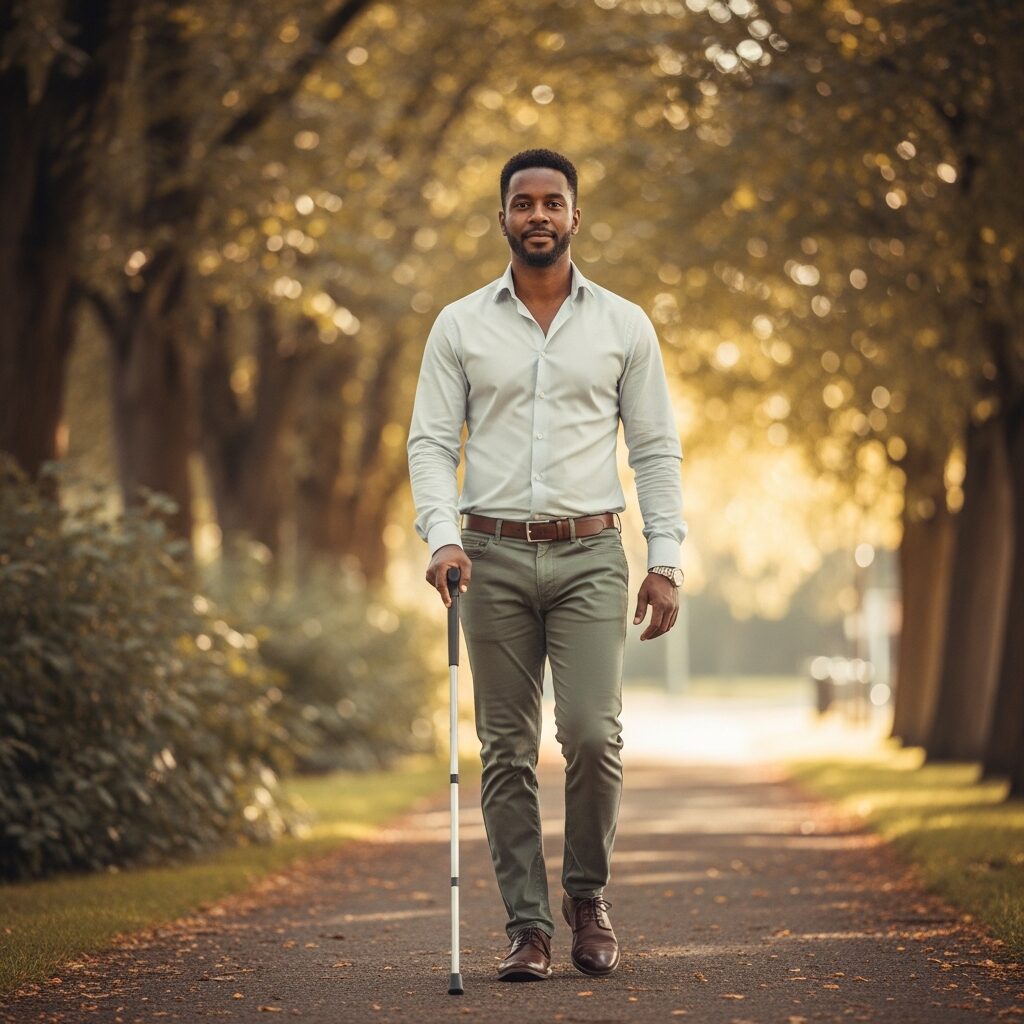
The white cane is the most reliable and affordable mobility tool there is. It detects obstacles and surface changes, and it signals to others that you have a visual impairment. You do not have to be totally blind to use one—and starting before you feel you “need” it is one of the smartest moves you can make.
Guide dogs are another option for some people, offering both mobility and companionship, though they require a real lifestyle commitment and an application process. Public transit, ride-share services, and sighted-guide techniques round out the picture, giving you several reliable ways to get where you are going. Our mobility aids guide covers each of these in depth.
The Emotional and Social Side of RP
Living with a progressive condition is not only a practical challenge—it is an emotional one, and that part deserves just as much attention. Because RP changes over time, the adjustment is not a single event. You may grieve a loss, find your footing, and then face a new change a few years later. That cycle is normal, and it does not mean you are doing anything wrong.
For many people, RP also raises questions of identity—shifting from thinking of yourself as fully sighted to living with a disability. Talking openly with family about your changing needs, even when it is hard, tends to reduce stress for everyone.
You do not have to carry this alone. National organizations like the Foundation Fighting Blindness and peer groups built around RP connect you with people who truly understand, and mental health professionals familiar with vision loss can be a real anchor. Many people also find that vision rehabilitation services—which focus on skills and independence rather than medical treatment—give them a sense of forward motion.
Because RP often begins in young adulthood, it can land in the middle of building a career, relationships, and a family. Workplace accommodations, vocational rehabilitation programs, and honest conversations with the people close to you all help you keep moving toward the life you want—which is exactly why support and proactive planning matter so much.
Living Well at Every Stage of RP
One of the most helpful things about understanding RP is that you can match your strategy to where you are right now—and get ready for what may come next. Here is a practical way to think about each stage.
Early stage (night blindness, full or near-full field). This is the time to build habits that pay off later. Improve the lighting in your home, get comfortable carrying a flashlight, and make the night-driving decision honestly. It is also a smart moment to learn what assistive tools exist, even if you do not need them yet.
Middle stage (narrowing field, tunnel vision). Scanning techniques and orientation and mobility training become valuable here, and many people begin white cane training during this phase. Magnification tools and smartphone accessibility features help you keep reading and working comfortably.
Later stage (significant field loss, possible central changes). Screen readers, text-to-speech, wearable technology, and full mobility training carry the most weight at this point. If you built familiarity with these tools earlier, this transition is far less jarring.
The thread running through every stage is the same: learning a skill before you urgently need it is always easier than learning it in a crisis. Progressive conditions reward planning, and you have more time to plan than it may feel like today.
Related Conditions: Usher Syndrome
Sometimes RP occurs alongside hearing loss, in a genetic condition called Usher syndrome. It is the most common inherited cause of combined vision and hearing loss, and it comes in three types with different patterns of onset and severity.
Managing both senses calls for specialized strategies that differ from vision or hearing loss alone—from communication methods that evolve over time to assistive technology that bridges both gaps. Early identification matters, because it allows coordinated care and earlier planning. If this applies to you or your family, our guide to Usher syndrome and dual sensory loss covers the types, communication strategies, and support resources in detail.
Frequently Asked Questions
Is retinitis pigmentosa considered low vision?
Yes. As RP progresses, it typically reduces vision to the point of meeting the definition of low vision, and some people become legally blind. The good news is that “low vision” means usable vision remains—and a wide range of tools and training help you make the most of it.
What age do you lose vision with retinitis pigmentosa?
It varies widely. Many people notice night vision changes in their teens or twenties and reach significant vision loss by around age 40, but the timeline depends heavily on your genetic type. Some people retain useful central vision well into later life.
Can retinitis pigmentosa be cured?
There is no cure yet, but research is active. One gene therapy is already approved for a specific inherited retinal condition, and clinical trials for other forms are ongoing. A diagnosis today does not mean the treatment landscape stays frozen—genetic testing can help you understand whether trials may apply to you.
What can make retinitis pigmentosa worse?
RP progresses on its own genetic timeline, not because of normal daily activities like reading or using screens. Protecting your eyes from excessive UV light and maintaining good overall health are sensible steps, and your eye care team can advise on anything specific to your type.
Take the Next Step
Wherever you are in your journey with retinitis pigmentosa, you do not have to figure it out alone. Because RP changes over time, the most powerful thing you can do is plan ahead—learning skills and exploring tools before you urgently need them, so each transition feels manageable instead of overwhelming.
NELVB specializes in helping people with RP stay independent at every stage, from early night blindness to advanced field loss. No obligation consultation to assess your current vision and build a plan that keeps you a step ahead.