State Assistive Technology Programs: Complete Directory
Trying to figure out what assistive technology you need, what it costs, and who can help you try it before you buy is exhausting — especially when every state seems to have a different program with a different name and different rules. If you have low vision, you have probably already run into this. The good news is that you do not have to navigate it alone, and you do not have to guess.
Every U.S. state and territory has a federally funded assistive technology program. These programs let you try devices for free, borrow them for weeks at a time, and in many cases get refurbished equipment at little or no cost. The services are real, most are free, and you do not need to be legally blind to use them. This directory walks you through what these programs offer, how to access yours, and what to expect by region.
What State AT Programs Offer
Every state assistive technology program is funded through the federal Assistive Technology Act, which is why people often call them AT Act programs. The Act requires every state to provide the same five core services, even though the program names look different from state to state. Once you know what to ask for, the system gets a lot easier to use.
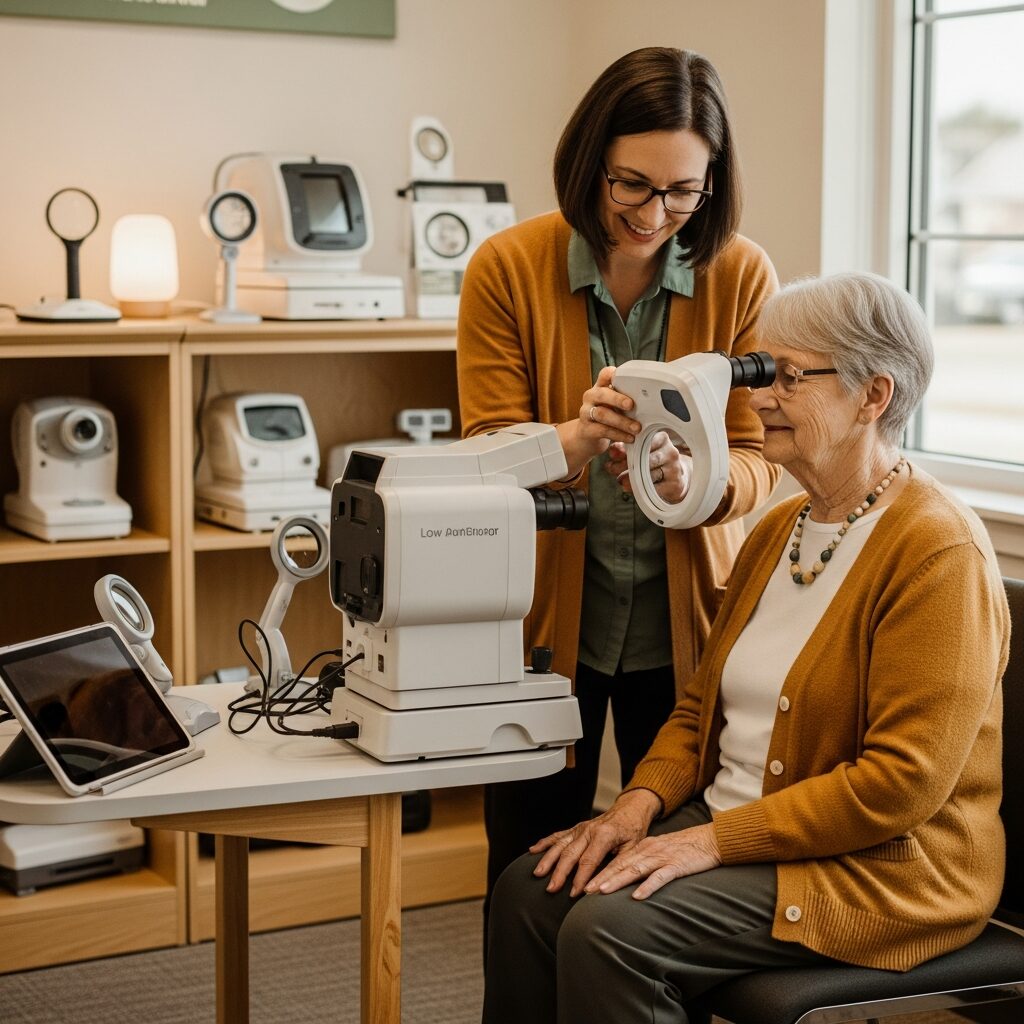
Device demonstration. You can sit down with a trained specialist and try video magnifiers, screen readers, smart glasses, OCR scanners, and other low vision tools side by side. There is no pressure to buy, and the specialist can show you how each device works for the tasks you actually do — reading mail, cooking, working, using your phone.
Short-term device loans. Most states will lend you a device for one to four weeks at no cost so you can use it in your real life — at home, at work, at school. This is the single best way to know whether a piece of assistive technology is worth the investment before you spend a dollar.
Reutilization. State programs collect gently used assistive technology, refurbish it, and pass it on at significantly reduced cost or free. Inventory rotates constantly, so a device that is not available today may show up next month.
Alternative financing. Many states partner with nonprofit lenders to offer low-interest loans for assistive technology purchases. These programs are designed for people who do not qualify for traditional financing and often consider disability-related expenses in a way banks do not.
Information and referral. If your need does not fit one of the four services above, your state program can point you to the right place — vocational rehabilitation, your state Commission for the Blind, Medicare resources, or another funding source.
How to Access Your State Program
The fastest way to find your state program is the national directory maintained by the Association of Assistive Technology Act Programs (ATAP) at AT3Center.net. You enter your state, and it gives you the official program name, website, and contact information.
You do not need a referral from a doctor or rehabilitation counselor in most states. You can call or email your state program directly and request a demonstration or loan. Many programs let you start the process online.
Income eligibility varies, but most core services — demonstrations, loans, and information — have no income requirement. Reutilization and alternative financing sometimes do, and the staff will walk you through it.
When you make first contact, it helps to bring a short list of the tasks you are struggling with (reading prescription labels, seeing your computer screen, recognizing faces) rather than a list of devices. Specialists are trained to match technology to tasks, and you will get better recommendations if you describe the problem before naming a product. Bring any vision documentation you already have, but do not wait for paperwork to call.
Northeast Region
If you live in New England, the mid-Atlantic, or New York, you have strong AT Act programs within driving distance. NELVB works directly with several of these and can help you coordinate between your state program and our low vision evaluations.
Massachusetts is served by MassMATCH, which runs demonstration centers and a statewide device loan library. Connecticut residents work with the CT Tech Act Project, housed at the state Bureau of Rehabilitation Services. New York has TRAID (Technology Related Assistance for Individuals with Disabilities), with regional centers across the state. New Jersey runs the Assistive Technology Center through the Department of Labor and Workforce Development. Pennsylvania has TechOWL at Temple University, one of the most active reutilization programs in the country.
Maine, New Hampshire, Vermont, and Rhode Island each have full AT Act programs as well — Maine CITE, ATinNH, the Vermont Assistive Technology Program, and the Rhode Island Assistive Technology Access Partnership (ATAP-RI). All five New England state programs maintain device lending libraries and can ship loaner devices to your home.
Southeast Region
Southeastern states have well-established programs, with Georgia and Florida running two of the largest reutilization operations in the country.
Florida is served by FAAST (Florida Alliance for Assistive Services and Technology), with regional demonstration centers across the state. Georgia runs Tools for Life out of Georgia Tech, including a statewide reuse program with thousands of devices. North Carolina has the NC Assistive Technology Program. Virginia is served by VATS (Virginia Assistive Technology System), and the Virginia Assistive Technology Loan Fund Authority offers low-interest loans for AT purchases. Tennessee runs the Tennessee Technology Access Program. South Carolina has SCATP at the University of South Carolina. Alabama operates STAR (Statewide Technology Access and Response). Kentucky is served by the Kentucky Assistive Technology Service Network.
Most southeastern programs ship loaner devices statewide, so rural residents are not penalized for distance.
Midwest Region
Midwestern programs are known for strong device demonstration centers and active loan libraries.
Ohio is served by Assistive Technology of Ohio at Ohio State University. Illinois runs IATP (Illinois Assistive Technology Program). Michigan has Michigan Assistive Technology Program at Michigan Disability Rights Coalition. Indiana runs INDATA out of Easterseals Crossroads, with one of the largest podcast and webinar libraries on assistive technology in the country. Wisconsin is served by WisTech. Minnesota runs the STAR Program (System of Technology to Achieve Results) through the Department of Administration. Iowa has the Iowa Program for Assistive Technology. Missouri operates Missouri Assistive Technology.
If you live in a smaller Midwest market, the program in your state will still ship devices to you and run virtual demonstrations.
West Region
Western states cover the largest geography, and program strength varies. Some run multiple regional offices, while others rely on shipping and virtual demonstrations.
California is served by Ability Tools, which runs reuse, lending, and financing statewide. Washington has the Washington Assistive Technology Act Program (WATAP). Oregon runs Access Technologies. Colorado is served by Colorado Assistive Technology Partners through the University of Colorado. Texas runs the Texas Technology Access Program. Arizona has the Arizona Technology Access Program (AzTAP). Nevada is served by Nevada Assistive Technology Resource Center. Utah runs the Utah Assistive Technology Program. New Mexico has the New Mexico Technology Assistance Program. Hawaii is served by the Hawaii Assistive Technology Resource Center. Alaska runs the Assistive Technology of Alaska program.
If you are in a rural part of the West, ask specifically about loaner shipping and virtual evaluations. These have expanded significantly in recent years.
Getting the Most from Your State Program
The biggest mistake people make with state assistive technology programs is treating them like a store. They are not — they are an evaluation system. Use them that way.
Request multiple device demonstrations before you make any purchase decision. If you are choosing between two video magnifiers, ask to demo both. If you are not sure whether a wearable device or a desktop video magnifier fits your life better, demo both categories. The specialists expect this and will not push you toward one product.
Use the lending library for a 30 to 60 day real-life test. A device that works in a 20-minute demo may not work for a 4-hour cooking afternoon or a long workday. Borrow it. Use it the way you actually live. Then decide.
Ask about reutilization inventory every few weeks. Refurbished devices appear and disappear quickly, and a polite check-in email keeps your name in front of the staff. Many people get a CCTV or smart magnifier this way for a fraction of retail.
Combine your state AT program with other funding. Vocational rehabilitation can pay for devices needed for employment. Your state Commission for the Blind may cover independent living technology. Free assistive technology programs can fill gaps in software and accessibility tools. Our complete assistive technology funding guide walks through how to layer all of these together so you do not pay for something that another program would cover. (Sibling cluster pieces on Medicare, vocational rehabilitation, free programs, and tax deductions are publishing soon.)
Frequently Asked Questions
Are state assistive technology programs free?
The core services — device demonstrations, short-term device loans, and information and referral — are free in every state, regardless of income. Reutilized devices are usually free or available at a steep discount. Alternative financing is a low-interest loan, not a grant, so you pay it back over time.
Do I need to be legally blind to use my state AT program?
No. State AT Act programs serve people with any disability, at any age, with no requirement that you be legally blind or have a specific diagnosis. If you are having trouble seeing well enough to do everyday tasks, you qualify for services.
How long can I borrow a device from a state AT program?
Most loan periods run between one and four weeks, with some programs offering 30 to 60 day extended evaluations for more complex devices like CCTVs or smart glasses. Shipping in both directions is usually paid by the program.
What is the AT Act?
The Assistive Technology Act of 1998 (reauthorized most recently in 2022) is the federal law that funds state assistive technology programs. It requires every state and territory to provide the same five core services. The Administration for Community Living (ACL) at the U.S. Department of Health and Human Services oversees the program, and the AT3 Center provides technical assistance to all 56 state and territory programs.
Can I keep a device I borrow from my state AT program?
Loaner devices have to come back — they are part of a shared library. But if you decide you want to keep the device, the program staff can usually point you to a reutilized version, an alternative financing option, or another funding source so you can get your own.
Take the Next Step
Your state assistive technology program is one of the most underused resources for people with low vision. The fact that demonstrations and loans are free, ship to your home, and do not require a diagnosis makes them a strong first stop before you spend any money on assistive technology.
NELVB works alongside state AT programs across New England — Massachusetts, Connecticut, Rhode Island, New Hampshire, Vermont, and Maine — and we can help you make sense of what your state offers, what we can evaluate in our offices, and how the two fit together. If you are not sure where to start, we will help you map it out.
Schedule a low vision consultation and we will help you build a plan that uses every resource available to you.