Peripheral Vision Loss from Glaucoma: Adaptation Strategies
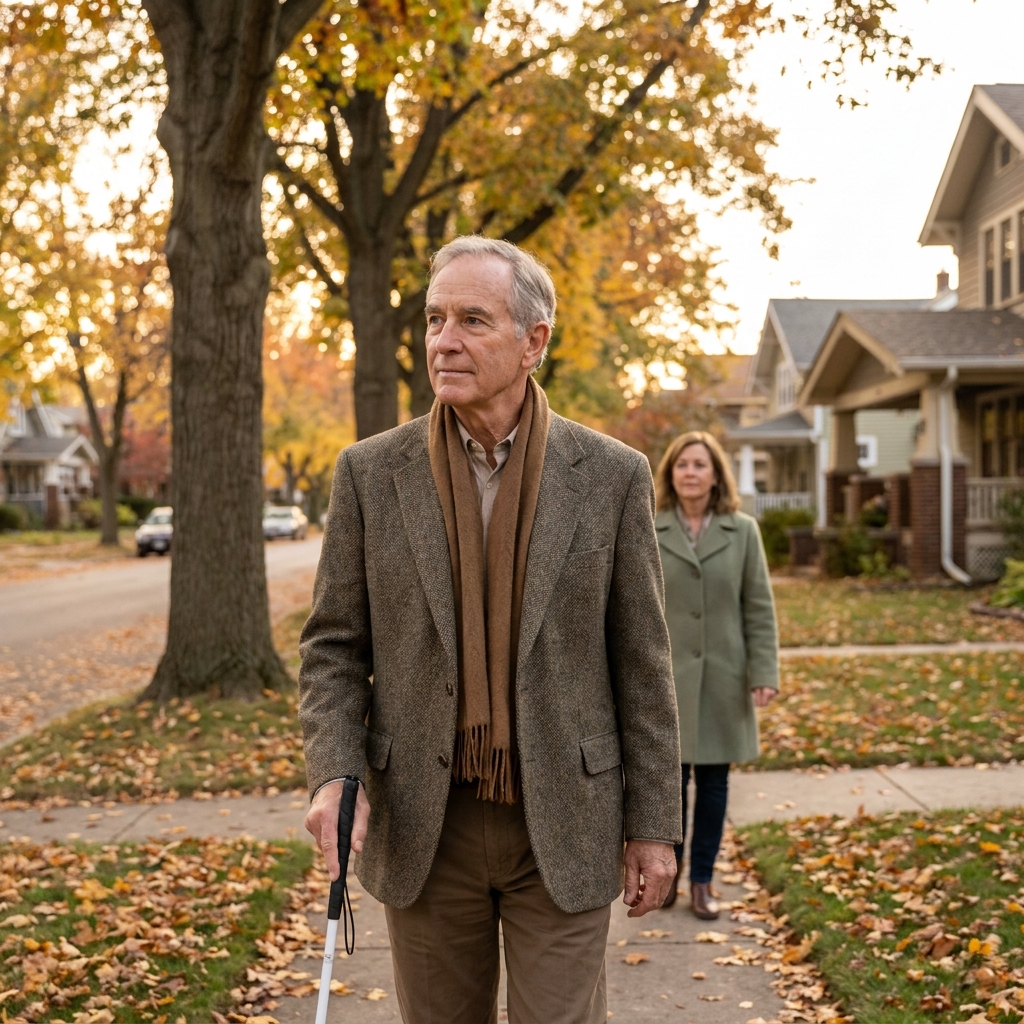
The hardest thing about peripheral vision loss is that you can’t see it happening. There’s no dark border closing in, no blurry edge. Your visual world looks complete right up until you clip a doorframe or miss a step you’d have sworn wasn’t there.
That gap between what you perceive and what you actually see is the whole problem — and it’s also what makes this adaptable. The core skill is replacing the automatic scanning your peripheral vision used to do with deliberate scanning you control. It’s learnable, it works, and most people are never taught it.
This guide covers the practical techniques: scanning, home setup, getting around, and the social situations nobody warns you about. For the broader picture of glaucoma care, see our guide to glaucoma and vision loss.
What You’re Actually Losing
Peripheral vision does more than most people realize. It isn’t a low-resolution afterthought around the edges of “real” vision — it’s a separate system doing separate jobs.
It detects motion, which is how you notice a car pulling out or a person stepping toward you. It provides spatial awareness, telling you where walls, furniture, and other people sit relative to your body. And it feeds balance, which is why field loss increases fall risk even when nothing is wrong with your legs or inner ear.
Glaucoma takes this gradually, narrowing the field from the edges inward. Late-stage loss is often described as tunnel vision: a clear central island with nothing around it.
The reason you don’t notice early is that your brain fills the missing regions with plausible content from nearby. You don’t see a gap. You see a seamless — and partly invented — picture.
Visual field testing is what makes the loss visible. Those printouts of grey and black squares are the objective record of what your perception is hiding from you, which is why they’re worth asking to see and keep.
Systematic Scanning
Scanning is the highest-value skill for glaucoma-related field loss. Nothing else on this page returns as much.
The principle: instead of looking where something catches your attention — which no longer works, because things in your blind zones can’t catch your attention — you move your gaze in a fixed, deliberate pattern so no region gets skipped.
Build the habit on three rules:
1. Move your head, not just your eyes. Eye movement alone stays inside a field that’s already restricted. Head movement brings genuinely new territory into your usable center.
2. Scan before you move, not while you’re moving. Scanning mid-stride means you’re committed to a path before you’ve checked it.
3. Use a consistent pattern. Left to right, then near to far. Consistency is what turns it into a habit instead of a chore.
The doorway protocol is worth adopting on its own. Every time you enter a new space — a room, a shop, a restaurant — stop at the threshold, scan the full width, then proceed. Doorways are where the environment changes fastest and where your remaining field tells you least.
In crowds, scan wider and more often, and slow down. Moving people generate exactly the kind of motion cue your peripheral vision used to catch automatically.
Reading about scanning helps. Practicing it with an orientation and mobility specialist helps considerably more — they watch what you’re actually doing, catch the regions you’re skipping without knowing it, and build the pattern into a reflex over a handful of sessions.
Setting Up Your Home
Your home is the one environment you fully control, so it’s where adaptation pays off fastest.
Keeping paths clear and predictable
Fix furniture in place. With field loss, memory does work your vision used to. A chair moved eighteen inches is a genuine hazard. If something has to move, tell everyone who lives there.
Keep walkways at least three feet wide and permanently clear. Shoes, bags, boxes, and pet bowls are the usual offenders — they sit low, exactly where field loss bites hardest.
Mark the edges of steps, thresholds, and level changes with high-contrast tape. Contrast is what your remaining vision uses best.
Add tactile markers at decision points — a textured strip at the top of the stairs, a marker on the correct thermostat button. Touch works when the field doesn’t.
Lighting
Even lighting matters more than bright lighting. Pools of light with dark gaps between them are worse than uniform moderate light, because hazards hide in the dark zones and your eyes have to keep readjusting.
Light every transition: stairs, entryways, the step down into a garage, the hallway to the bathroom. Night lights throughout are cheap and prevent a category of fall that’s common and entirely avoidable.
Kitchen and bathroom
In the kitchen, everything gets a fixed home and stays there. Mark counter edges and the stove’s off position with contrast tape or bump dots. Reach for pans by memory and touch rather than searching visually.
In the bathroom, install grab bars — peripheral field loss affects balance, and wet floors compound it. A contrasting bath mat and toilet seat make both easier to locate without hunting.
Our broader guide to adaptive techniques for daily living with low vision covers more of these room by room.
Getting Around Outside
A white cane is the single most useful mobility tool for significant peripheral loss, and it doesn’t require total blindness. It detects curbs, steps, and obstacles in exactly the zone your field no longer covers, and it signals to everyone around you that you may not see them coming.
The resistance most people feel is about identity, not utility — it feels like an announcement. Worth weighing against what it prevents. Our guide to white canes and mobility aids for progressive vision loss covers how that decision usually plays out.
Sighted guide technique — taking someone’s arm just above the elbow and walking half a step behind — is a real skill with a right way to do it, and it makes unfamiliar or crowded places far easier. Teach it to the people you go places with.
On public transport, position yourself with your back to a wall so you only have to monitor one direction. Ask drivers to call your stop; most will.
Shopping goes better with a consistent route through a familiar store, at off-peak hours. Asking staff for help finding items is faster than scanning shelves, and most stores will walk you through.
Driving is the question people most want to avoid asking. Peripheral vision is precisely what driving depends on, and central acuity can stay sharp long after the field has narrowed past what’s safe or legal. Requirements vary by state, and your visual field test is what determines where you stand. Our complete guide to driving with low vision covers the requirements and the alternatives worth arranging early.
The Social Part
This gets left out of most clinical advice, and it causes real damage.
When someone approaches from your blind side and you don’t respond, they read it as a snub. You seem to ignore a wave across a room, or fail to greet a neighbor. Over time, people quietly conclude you’ve become cold, and you have no idea it’s happening.
The fix is telling people. Not a speech — one sentence. “My side vision is limited, so come at me from the front or say my name.” Most people adjust immediately and are glad to know.
At gatherings, choose your seat deliberately. Back to a wall, facing the door, so everyone in the room falls inside your remaining field rather than approaching from behind. Arriving a few minutes early makes this easy.
In group conversation, position yourself where the most faces fall in your central field — the end of a table rather than the middle of one side.
With family, ask people to identify themselves when they enter a room and say when they’re leaving. It sounds fussy for about a week and then becomes normal.
Where to Start
If you do one thing from this page, make it working with an orientation and mobility specialist on scanning. It’s the skill with the widest reach, and it’s very hard to build correctly on your own — the regions you skip are, by definition, the ones you can’t tell you’re skipping.
New England Low Vision and Blindness provides functional vision assessment and training services across New England, covering scanning technique, mobility, and the home adaptations that fit your specific field loss.
Frequently Asked Questions
Can peripheral vision loss from glaucoma be reversed?
No. Optic nerve damage is permanent. What can change substantially is how well you function with the field you have — which is what scanning technique, home setup, and mobility training address.
Why don’t I see black areas where my vision is missing?
Your brain fills in missing regions with information from the surrounding field. You perceive a complete picture rather than gaps, which is why field loss is usually discovered through testing or through bumping into things rather than through noticing it directly.
How do I know how much peripheral vision I’ve lost?
Visual field testing. Ask your ophthalmologist to show you your results and explain the pattern — knowing which parts of your field are affected is what lets you target adaptations rather than guessing.
Do I need a white cane if I can still see fairly well?
It depends on your field, not your acuity. Many people with good central vision and significant peripheral loss benefit from a cane for detecting obstacles and steps. It’s a tool matched to a specific problem, not a marker of how much vision you have left.
Will magnifiers help with peripheral vision loss?
Usually not. Magnification enlarges an image, pushing more of it outside the field you have left. Magnifiers become relevant if glaucoma later affects your central vision. For peripheral loss, contrast, lighting, and scanning do more.
Does peripheral vision loss increase fall risk?
Yes. Peripheral vision contributes to balance and to detecting obstacles at ground level. This is why lighting, clear pathways, contrast marking on steps, and bathroom grab bars matter more than they would otherwise.
Talk With Someone Who Understands Vision Loss
You don’t have to sort this out on your own. New England Low Vision and Blindness can help you understand your options and build a plan around your life — whether you’re living with low vision or you are blind.
Schedule No-Obligation Consultation or call us at 888-211-6933.