Living Well with Diabetic Vision Loss
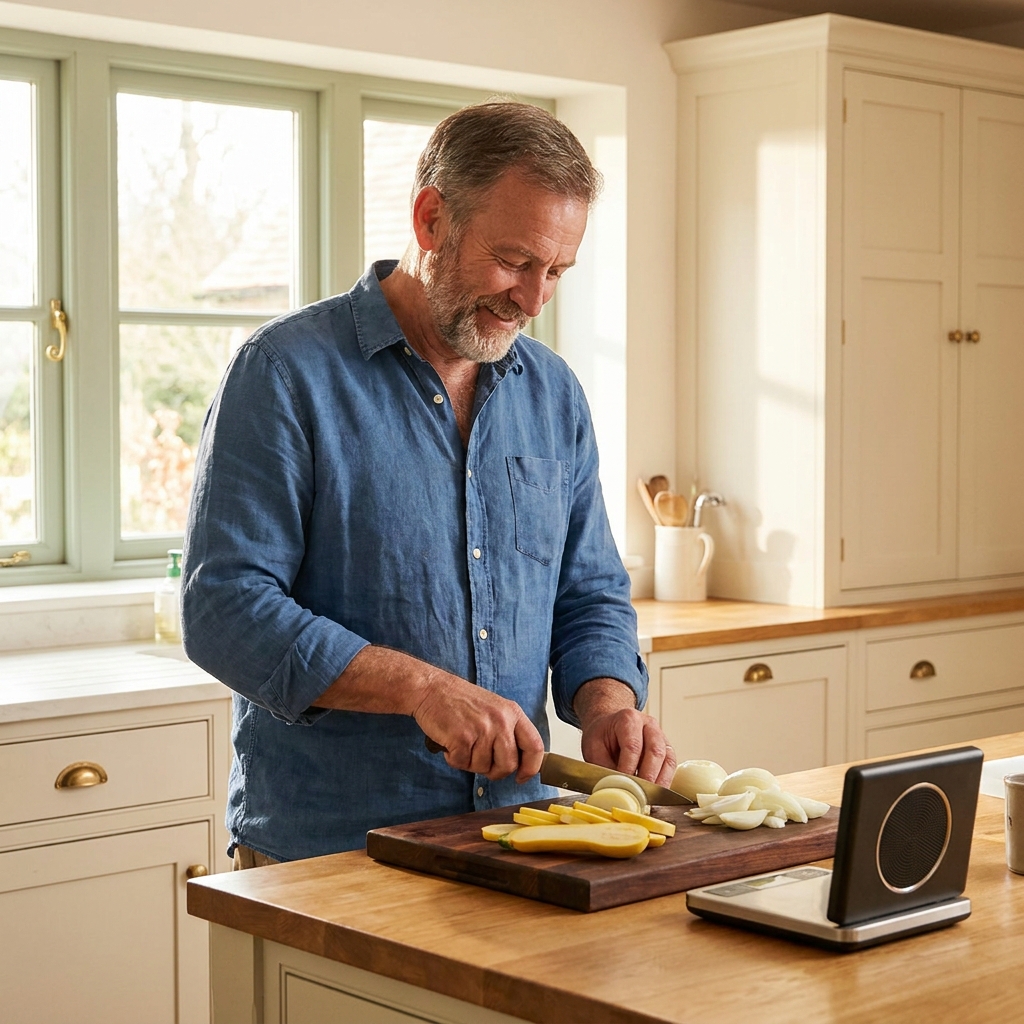
Diabetes was already a full-time job. Then your vision changed, and every part of that job got harder at once.
There’s a particular exhaustion to this that people managing a single condition don’t experience — the sense that you’re now doing two demanding things badly instead of one thing well. It’s worth saying plainly: that feeling is a workload problem, not a character problem, and workload problems have practical solutions.
The approach that works is to stop trying to do everything the way you used to, more carefully. Instead, redesign the tasks so they don’t depend on vision in the first place. Systems, not effort.
This guide covers the daily side of that — meals, cooking, exercise, work, travel, and the people around you. For devices, see our guide to low vision aids for diabetic retinopathy.
Meals: The Task That Carries the Most Weight
Diet is where diabetes and vision loss collide hardest, because carbohydrate counting is a reading task and cooking is a precision task.
Carbohydrate counting. Phone apps read nutrition labels aloud through the camera. Talking kitchen scales weigh portions. But the most effective strategy is one people arrive at on their own: build a rotation of twenty or so meals you know the numbers for, and stop recalculating from scratch. Reduces reading, reduces error, reduces decision fatigue.
Food labels. OCR apps handle unfamiliar products, and a handheld reader like the OrCam Read does the same job without a phone. For regulars, memory and consistent shelf placement do the work. Ask your grocery store about shopping assistance — most will pair you with staff, and some offer it by appointment.
Consistent storage. Everything gets a fixed place in the fridge and pantry, and stays there. This single habit removes most label-reading from daily life.
Cooking safely. Bump dots on the oven dial at your common temperatures. A dark cutting board for light foods and a light board for dark ones. Liquid level indicators that beep as a cup fills. Long oven mitts, and pan handles always turned inward.
Portion control by tool, not by eye. Measuring cups and a talking scale beat visual estimation, which drifts badly as vision changes.
Restaurants. Most chains publish nutrition information online where your phone can read it aloud — decide before you go. Menu apps and phone magnification handle the rest.
Keeping Physical Activity in the Picture
Exercise remains one of the strongest tools you have for blood sugar control, and it’s frequently the first thing dropped after vision changes. Usually not from unwillingness, but because the walk that used to be easy now feels unsafe.
That’s a solvable problem rather than a reason to stop.
- Stationary equipment — bike, treadmill with familiar settings, rower — removes navigation entirely
- Water exercise is excellent for this: no obstacles, low fall risk, and easy on the feet
- Seated strength work with resistance bands or light weights requires no travel and no visual tracking
- Walking with a companion or guide, or on a familiar measured route
- Audio-guided workout apps describe movements aloud rather than showing them
Two diabetes-specific cautions. Check your feet after exercise every time, or have someone check them — this is the highest-risk gap when vision is reduced. And carry fast-acting glucose, since recognizing early hypoglycemia symptoms is harder when you’re also managing an unfamiliar activity.
Appointments and Working with Your Care Team
Diabetic retinopathy multiplies appointments. Endocrinology, ophthalmology, podiatry, primary care, and often monthly eye injections on top.
Transport is the most common reason people fall out of treatment. It is also the most fixable, and clinics rarely ask. Say directly that transport is a barrier — many practices can arrange help, and paratransit, Medicaid transport benefits, and volunteer driver programs all exist.
Bring someone, or record. Ask permission to record instructions on your phone. Written after-visit summaries are useless if you can’t read them — a text-to-speech reader will read a printed page aloud, or ask for instructions to be emailed so your device can read them, or ask the nurse to talk you through them before you leave.
Consolidate where possible. Ask whether appointments can be scheduled the same day to cut travel.
Say what you can’t see. If you can’t read your meter, can’t inspect your feet, or can’t read a label, tell your care team. These are clinical facts that change your management plan, and people routinely hide them out of embarrassment while their control quietly deteriorates.
Work
Diabetic retinopathy is the leading cause of blindness in working-age adults, which means many people facing it are employed and intend to stay employed.
Screen magnification and screen reading software, high-contrast displays, and good task lighting cover a great deal. Vocational rehabilitation services in every state fund workplace assessment and equipment, and they’re substantially underused.
You’ll also need somewhere private and predictable to test blood sugar and take insulin. That’s a reasonable accommodation, and asking for it is normal.
Travel
Travel is very manageable with preparation.
Carry double the diabetes supplies you expect to need, split between two bags. Keep a letter from your doctor for airport security regarding insulin and needles. Airlines and stations provide assistance if you request it in advance — request it, even if you feel you might not need it.
Time zone changes affect insulin timing; work the plan out with your diabetes team before you leave rather than improvising.
Feet, and Why This One Can’t Slide
Of everything on this list, daily foot care is the task where reduced vision does the most damage — and it’s the one most quietly abandoned.
Diabetic foot problems begin small and painless. Reduced sensation means you often can’t feel a blister, a cut, or a pressure sore, so daily visual inspection is the detection system. Take that away and problems are found late, when they’re serious.
Build a system that doesn’t depend on your own eyesight:
- A long-handled inspection mirror lets you check the soles yourself
- Have someone else look — a partner, a family member, a home health aide — as a scheduled routine rather than an occasional favor
- Ask your podiatrist for more frequent visits. Reduced vision is a legitimate clinical reason for a shorter interval, and most will adjust once you explain
- Check by touch as well. Run your hands over your feet daily for warm spots, swelling, or rough patches
- Shake out your shoes before putting them on, every time
Tell your care team directly if you can no longer inspect your own feet. It changes your risk category and should change your care plan — and it’s exactly the kind of thing people hide out of embarrassment while a problem develops.
The People Around You
Vision loss changes relationships in ways that catch people off guard.
Tell people what you need specifically. “Say your name when you come in” and “tell me where you’ve put things” are more useful than a general announcement about your vision.
Watch the help balance. Family members often want to take over diabetes management, and it comes from love. But handing over your own management tends to reduce both your independence and your control, because nobody tracks your body as closely as you do. Accept help with specific tasks; keep the decisions.
Say the unsaid part. Many people with diabetic retinopathy carry a private conviction that they caused this. Retinopathy occurs in people with excellent control and spares some with poor control — duration, genetics, and blood pressure all contribute. Guilt is a heavy thing to manage alongside two chronic conditions, and it changes nothing about what happens next.
Get help if the weight is real. Depression is more common in people managing both diabetes and vision loss, and it directly undermines self-management — which makes it a medical problem, not a mood. Our article on depression and vision loss covers what to watch for.
Find people in the same situation. Diabetes groups and low vision groups both exist, and people managing both are common enough that you won’t be explaining yourself from scratch.
Where to Start
Pick the one task that’s currently going worst and fix that single thing.
For most people it’s blood sugar testing or medication management, and both have straightforward solutions. Fixing one thing properly restores more confidence than half-fixing five.
New England Low Vision and Blindness works with people across New England on exactly this — functional vision assessment and training services that keep daily life and diabetes management workable together.
Frequently Asked Questions
How do I manage diabetes if I can’t read my glucose meter?
Talking glucose meters announce readings aloud, and continuous glucose monitors send readings to a phone that can speak them. Both are widely available and often covered as diabetes equipment. Tell your diabetes team you’re having trouble reading your meter — it changes what they can prescribe.
Can I still cook safely with diabetic vision loss?
Yes, with adaptations. Tactile markings on appliance controls, contrasting cutting boards, liquid level indicators, and a consistently organized kitchen handle most of it. A low vision therapist can assess your kitchen and set it up with you.
Should I keep exercising if my vision has changed?
Yes — exercise remains a key part of blood sugar control. Change the format rather than stopping: stationary equipment, water exercise, seated strength work, or walking with a companion. Check your feet afterward every time.
How do I count carbohydrates without reading labels?
Phone apps read labels aloud through the camera, and talking kitchen scales handle portions. Most people find the bigger win is building a rotation of familiar meals with known carbohydrate counts, which removes most label reading from daily life.
Can I keep working with diabetic retinopathy?
Most people can. Screen magnification and screen reading software, high-contrast displays, and task lighting cover many roles, and state vocational rehabilitation services fund workplace assessment and equipment. A private, predictable place to test and dose is a reasonable accommodation to request.
Is it normal to feel guilty about diabetic retinopathy?
It’s very common, and it isn’t accurate. Retinopathy develops in people with excellent blood sugar control and spares some with poor control; duration of diabetes, blood pressure, and genetics all play a part. If guilt is affecting how you manage your care, it’s worth raising with your care team.
Talk With Someone Who Understands Vision Loss
You don’t have to sort this out on your own. New England Low Vision and Blindness can help you build a plan around the tasks that matter most in your day — whether you’re living with low vision or you are blind.
Schedule No-Obligation Consultation or call us at 888-211-6933.