Managing Light Sensitivity While Driving
Light sensitivity while driving is one of the most common challenges reported by people with low vision, and it affects both daytime and nighttime driving in distinct ways. The sun reflecting off a wet road, oncoming LED headlights at night, the sudden transition from a dark tunnel to full daylight — each of these situations can feel overwhelming when your eyes are more sensitive to light than they once were.
The good news is that light sensitivity driving challenges respond well to a combination of targeted strategies. There is no single solution that works for everyone, because the eye conditions that cause light sensitivity each produce different patterns of sensitivity that respond to different approaches. But there is a practical toolkit available, and most people with low vision find that applying even a few of these strategies significantly reduces the difficulty of driving with light sensitive eyes.
This guide covers the causes of light sensitivity in drivers with low vision, strategies for daytime and nighttime conditions, vehicle modifications worth considering, and clear guidance on when worsening symptoms are a reason to see a specialist.
What Causes Light Sensitivity While Driving?
Understanding what is causing your light sensitivity is the first step toward managing it effectively. The same symptom, glare that makes it hard to see, can have very different causes that call for different solutions.
Eye Conditions That Increase Light Sensitivity
Cataracts are one of the most common causes of driving-related light sensitivity. The clouded lens scatters incoming light rather than focusing it cleanly, creating a diffuse haze that is particularly bad in bright sunlight and at night when oncoming headlights hit the scattered lens. People with cataracts often describe halos around light sources and difficulty seeing in high-contrast situations like driving from shade into bright sun.
Macular degeneration affects the central retina, which processes fine detail and adapts to changes in light levels. People with macular degeneration often experience longer adaptation times when light conditions change suddenly, making transitions like entering or exiting tunnels particularly disorienting.
Diabetic retinopathy can cause areas of retinal damage that are unusually sensitive to light in specific parts of the visual field. The sensitivity pattern varies depending on where the damage is located, which is why condition-specific evaluation matters for finding the right management approach.
Corneal conditions such as keratoconus or dry eye disease affect how the cornea focuses and transmits light. Dry eye in particular creates an irregular tear film that scatters light across the corneal surface, producing glare even in moderate lighting conditions. This is often worse at night when tear production slows and the eye is more fatigued.
Post-surgical sensitivity following cataract surgery or LASIK is common during recovery and can persist for months. The new intraocular lens or reshaped cornea adjusts to focusing light differently, and some people experience heightened glare sensitivity during this transition.
Other Causes of Light Sensitivity While Driving
Migraines and photophobia produce light sensitivity that is neurological rather than optical in origin. For migraine-associated photophobia, the eye itself may be functioning normally, but the brain’s processing of light signals is disrupted. This requires different interventions than optical scatter, specifically FL-41 tinted lenses that filter the wavelengths most likely to trigger migraine response.
Medications are an underappreciated cause of increased light sensitivity. Several common drug classes increase photosensitivity, including some antibiotics (tetracyclines, fluoroquinolones), diuretics, antidepressants (SSRIs), and some blood pressure medications. If your light sensitivity has increased after starting a new medication, it is worth checking the medication’s side effect profile and discussing it with your prescribing physician.
Traumatic brain injury frequently causes photophobia that affects driving. Many TBI survivors report that light sensitivity is one of their most disabling symptoms because it is invisible to others while profoundly affecting their daily functioning.
Normal aging also reduces the pupil’s ability to respond quickly to changing light levels. Older adults often need more time to adapt when moving between bright and dim environments, which is why transitions can feel more difficult even for people without a diagnosed eye condition.
Daytime Driving Strategies
Daytime light sensitivity is primarily about managing reflected glare from roads, other vehicles, and bright surfaces. These strategies address both what you wear and how you configure your driving environment.
Choosing the Right Sunglasses
For daytime driving, polarized lenses are generally the most effective glare-reduction technology available. Unlike AR coatings or tinted lenses, polarized lenses specifically block horizontally polarized light, which is the type produced by glare reflected from flat horizontal surfaces like roads, car hoods, and water. This is the glare that makes it hard to see lane markings on a bright day or causes a blinding effect when driving toward a setting sun over wet pavement.
Frame style matters as much as lens technology. Wraparound frames that block light from the sides significantly reduce the total glare load on light-sensitive eyes. Standard frames leave peripheral light sources fully exposed, which forces your visual system to constantly manage competing light intensities from multiple directions.
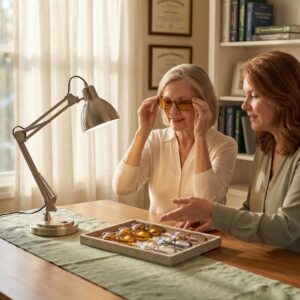
Tint color for daytime use: Gray lenses provide the most neutral color perception, which is useful for accurately judging traffic signal colors and reading road signs. Brown lenses enhance contrast slightly, which some drivers with macular conditions find helpful. Copper and amber lenses provide the most contrast boost and work well for driving on overcast days or in haze.
Fitover options are practical for people who already wear prescription glasses and do not want to invest in prescription sunglasses immediately. Quality fitovers with polarized lenses from manufacturers like NoIR or Cocoons are available for $30-$80 and perform well for most daytime driving situations.
Vehicle and Route Adjustments
A clean windshield is one of the highest-impact changes you can make. The interior surface of most windshields accumulates a film of dust and off-gassing residue from dashboard materials. This film scatters every incoming light source, amplifying glare from the sun, oncoming vehicles, and streetlights. Cleaning the interior glass surface with glass cleaner and a lint-free cloth immediately reduces glare for most drivers.
Use your sun visor actively. The visor blocks direct sun from above but does not address glare below the visor’s edge. Extended visor accessories that clip onto factory visors are available for about $15-$30 and provide additional coverage for low-sun-angle driving in early morning and late afternoon.
Route planning around sun angle is an underrated strategy. East-west routes driven at dawn or dusk put you driving directly into the sun. If you have flexibility in your schedule or route, shifting departure times by 30-60 minutes or choosing north-south oriented routes can dramatically reduce sun glare exposure.
Side window shades reduce glare from vehicles alongside you in traffic and from buildings and water on the driver’s side. Retractable mesh shades are legal in most states in rear windows and rear side windows, though front window regulations vary. Check your state’s rules before installing.
Dashboard and Interior
Reduce your dashboard brightness to the lowest comfortable level when driving in bright conditions. The contrast between a bright instrument panel and the bright road environment is lower priority, but at dusk and in variable light conditions, a bright dashboard can create competing visual demands that increase fatigue.
Avoid placing reflective objects on your dashboard. Phone mounts, GPS holders, and decorative items on the dashboard surface can catch light and create focal glare points directly in your forward visual field.
Nighttime Driving and Headlight Glare
Nighttime light sensitivity presents different challenges than daytime glare, and strategies that work during the day may not apply or may even be counterproductive at night.
Why Headlights Are the Biggest Challenge
Modern LED and HID headlights produce significantly more light than the halogen headlights that were standard until the 2010s. Estimates vary, but LED and HID systems produce approximately 2-3 times more lumens than comparable halogen systems. More critically, the light they produce is weighted toward blue-white wavelengths, which scatter more inside the eye than the warmer yellow-orange spectrum of halogen lights.
For people with cataracts, macular conditions, or any degree of lens clouding, this blue-weighted scatter amplifies the glare effect significantly. Oncoming LED headlights that might produce mild discomfort for a young person with healthy vision can temporarily overwhelm the visual system of a driver with low vision, making it difficult to see the road for several seconds after the vehicle passes.
Wet roads compound the problem by reflecting headlights upward, effectively doubling the glare source for drivers moving through rain or driving on recently wet surfaces.
Strategies for Nighttime Glare
Anti-glare glasses with AR coating are the most effective single intervention for nighttime headlight glare. Anti-reflective coating eliminates internal lens reflections that multiply the apparent intensity of every light source. Paired with blue light filtering, AR coating specifically addresses the LED headlight wavelength problem. For specific product options, see our guide to best night driving glasses for low vision. For a deeper explanation of how the technology works, see our guide to anti-glare glasses for night driving.
Look toward the right edge of the road when oncoming headlights are present, rather than toward the oncoming vehicle. The right road edge line provides a reliable navigation reference, and directing your gaze away from the headlights protects your dark adaptation and reduces the recovery time after the vehicle passes.
Increase your following distance at night, particularly in areas with frequent oncoming traffic. A longer following distance gives you more time to process visual information between glare events and more margin for error if your glare recovery takes longer than expected.
Avoid looking at your phone screen at stoplights. Your eyes begin adapting to lower ambient light levels within seconds of stopping in a dark area. Looking at a bright screen resets that dark adaptation, which means you will be starting the recovery process again when you pull away. Keep your phone screen face-down or turned off when the car is stopped.
Reduce your dashboard brightness to the lowest usable level at night. Unlike daytime driving where dashboard brightness is a lower priority, at night the contrast between interior lighting and the dark road environment directly affects your dark adaptation and your ability to see low-contrast details outside the vehicle.
When to Limit Night Driving
There are conditions under which limiting or avoiding night driving is the right decision, not a failure or a loss of independence. Driving safely requires honest assessment of your functional capabilities in current conditions.
Consider limiting night driving if:
- Your glare recovery time after oncoming headlights consistently exceeds 5 seconds
- You have difficulty seeing lane markings between streetlights, particularly in areas with no street lighting
- You consistently misjudge the distance of oncoming vehicles at night
- Fatigue significantly worsens your light sensitivity during evening driving
These experiences do not necessarily mean you should stop driving entirely. Many people with low vision continue driving safely on familiar routes, in well-lit areas, or at limited times of day. A functional vision evaluation can help clarify what conditions are safe for you specifically, which is more useful than a blanket restriction.
Vehicle Modifications for Sensitive Eyes
Your glasses address light at the lens. Your driving environment is the other half of the equation. These vehicle modifications are specifically relevant for light-sensitive drivers and represent an underserved area in most driving guides.
- Auto-dimming rearview mirror: Standard mirrors reflect the full brightness of headlights behind you directly into your eyes. Auto-dimming mirrors detect high-brightness reflections and automatically reduce the mirror’s reflectivity. This is one of the highest-value modifications for nighttime driving sensitivity, and many vehicles come equipped with this feature or offer it as an affordable option. Aftermarket auto-dimming mirrors are available for most vehicles for $50-$150.
- After-market tinted windows: Window tinting reduces the total light entering your vehicle, which can meaningfully reduce daytime glare in high-sun conditions. Check your state’s legal limits for front window tinting, as regulations vary significantly. Most states allow tinting of rear and rear side windows with fewer restrictions than front windows. Use a licensed installer who is familiar with your state’s specific requirements.
- Backup camera: Backup cameras reduce the need to turn your head to check behind you when reversing, which is valuable when bright parking lot lights or direct sunlight behind the vehicle create a difficult-to-manage glare situation. Most vehicles manufactured since 2018 include backup cameras as standard equipment.
- GPS with voice navigation: Reducing the need to look at a screen for navigation directions means less screen glare and less time with your eyes redirected from the road. A quality voice navigation system with a screen that dims automatically in low light removes one source of contrast challenge.
- Warm-tone interior LED lighting: If your vehicle’s interior LED lights are cool-white, replacing dome and ambient lights with warm-tone LEDs reduces the harshness of interior lighting and improves the transition between interior and exterior visual environments.
- Extended sun visor add-ons: Clip-on visor extensions that attach to your existing sun visor provide additional coverage for low-angle sun without blocking your forward view. These are particularly useful for morning and evening commutes on east-west routes.
When Light Sensitivity Means It’s Time for Professional Help
Most light sensitivity driving strategies can be implemented independently. But there are situations where the right move is professional evaluation, and recognizing them matters.
New or rapidly worsening light sensitivity should always be evaluated. If your sensitivity to light has increased noticeably over weeks or months, that is a symptom of a changing eye condition, not just an inconvenience to manage with better sunglasses. Conditions like cataracts, glaucoma, and diabetic retinopathy progress, and changes in light sensitivity are often early indicators that a condition has changed.
Light sensitivity interfering with activities beyond driving warrants professional attention. If you are avoiding indoor activities, struggling with grocery store lighting, or having difficulty with screens and reading in addition to driving challenges, your light sensitivity has become functionally disabling and responds well to comprehensive low vision evaluation.
Migraine-associated photophobia increasing in frequency may indicate that your migraine management needs adjustment, not just better driving glasses.
Glare recovery time exceeding 5 seconds after direct light exposure is a functional driving safety concern that deserves evaluation rather than just self-management.
At New England Low Vision and Blindness, our evaluations include glare recovery time testing, contrast sensitivity assessment, and functional vision evaluation that goes beyond what a standard eye exam measures. We can identify the specific mechanisms behind your light sensitivity and recommend targeted solutions, including clinical-grade filters matched to your visual profile, rather than general-purpose products.
For a complete overview of driving with low vision including bioptic telescopes and other adaptive devices, visit our complete guide to driving with low vision. If you are wondering whether a bioptic telescope might help you drive more safely, see our guide to bioptic driving requirements. To learn more about our evaluation services, visit our low vision services page.
Take the Next Step
Managing light sensitivity while driving is very much possible for most people with low vision. The right combination of glasses, vehicle adjustments, and behavioral strategies can make driving significantly more comfortable and safe. The best combination for you depends on your specific eye condition, the type of sensitivity you experience, and when and where you drive most often.
Our low vision specialists offer free consultations that include a functional evaluation of your light sensitivity and driving vision. We do not start with a product recommendation. We start by understanding what you are experiencing, what conditions are most challenging, and what your driving goals are. Then we help you build a practical approach.
There is no commitment and no pressure. Just expert guidance toward solutions that match your real situation.