Magnifiers for Hobbies: Knitting, Sewing, Puzzles and Crafts with Low Vision
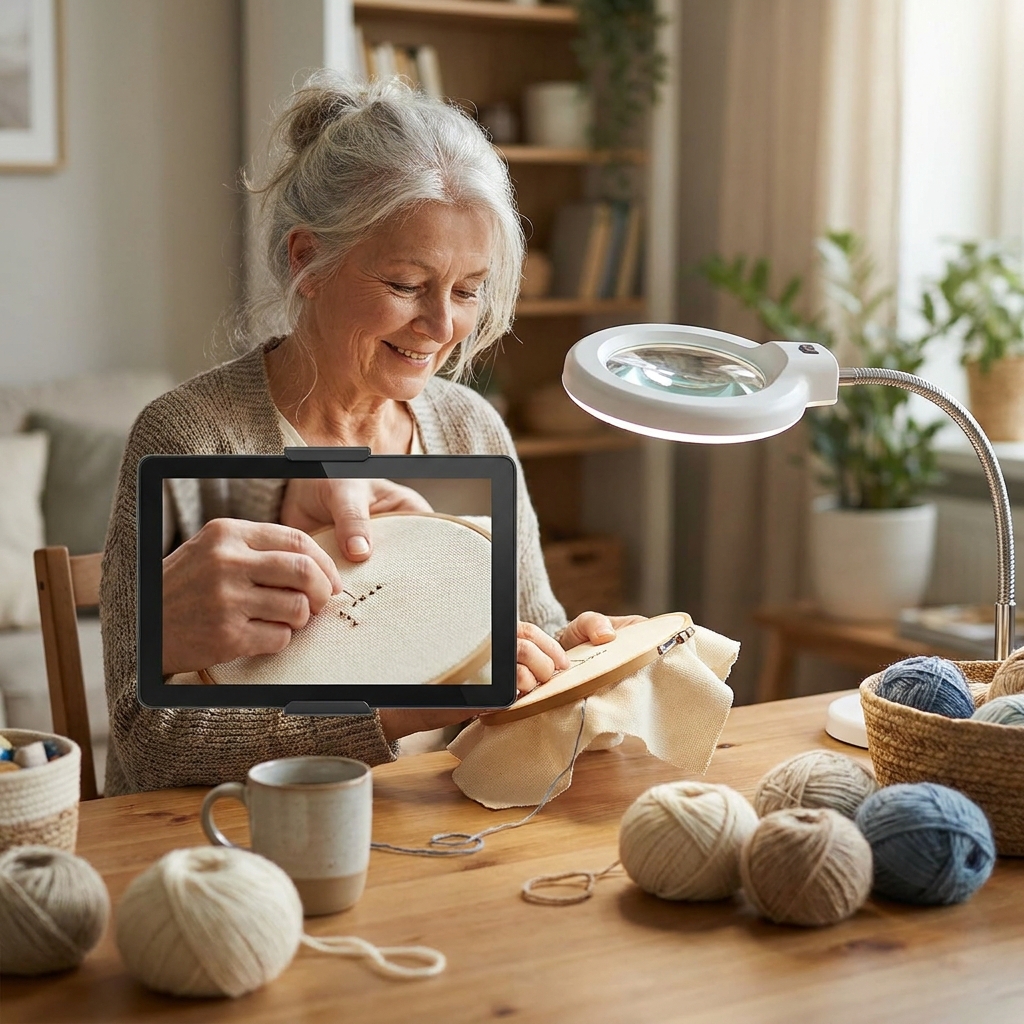
A hobby is more than a way to pass time. It’s the part of your day that’s yours. When the stitches blur or the puzzle pieces look alike, it’s easy to put it down and tell yourself you’re done with it.
You don’t have to give it up. Good light, plus the right magnifier for how you work, can bring your hobby back. For most crafts, the key question is whether you need your hands free. This guide goes through the options, starting with what costs little.
Take it one step at a time.
Why Hobbies Are Different From Reading
Reading is a one-hand job. You hold a page and a magnifier, and you move along a line.
Crafts ask more of you. You hold a needle in one hand and fabric in the other. You sort tiny puzzle pieces. You paint, glue, or build, and your hands are busy the whole time.
That changes what you need. A magnifier that works for a letter may get in your way at a sewing table. So the first question isn’t “how strong?” It’s “how do I want to hold it?”
Start Here: Light and Contrast
Try these before you buy anything. For many people, light does most of the work.
- Add a bright lamp. Place it to one side so your hands don’t cast shadows on your work.
- Make the work stand out. Put light thread on a dark cloth, or dark pieces on a light tray. Contrast helps your eyes find the edge.
- Sort and organize. A tray with small sections keeps beads, buttons, and puzzle pieces from rolling away.
- Pick the right supplies. Thicker needles, larger beads, and patterns in large print are all easier to see.
- Take short breaks. Rest your eyes every 20 or 30 minutes.
For more on lighting, see our guide to home lighting for vision impairment.
Three Kinds of Magnifiers for Hobbies
Each type suits a different way of working.
- A lit handheld lens. You hold it over your work. It’s simple, light, and costs the least.
- A video magnifier with a stand. A camera and screen sit on a stand, so both hands stay free.
- A desktop video magnifier. A large screen on a table, with room to see more of your project at once.
Lit Handheld Magnifiers
A handheld lens with a built-in light is the easiest place to start. It works well when you can set your work down for a moment, or when you only need a closer look at a detail.
- Mr. Magnifier Handheld Illuminated Magnifier ($139). A lens with a bright LED light and a lifetime warranty. It comes in more than one strength, so you can pick the one that suits you.
- Clover 3 Handheld Magnifier ($279). Up to 3x magnification with LED lighting and one-button operation. Its product page lists hobbies and crafts, such as model building, among its uses.
- Clover 4 Handheld Magnifier ($449). The same style, with up to 4x magnification.
A stronger lens shows a smaller area at a time, so more magnification isn’t always better. If you can, try more than one strength.
Hands-Free Video Magnifiers With a Stand
If you sew, knit, or build, a stand is the feature to look for. It holds the screen at the right angle, and your hands stay on your work.
- Clover 7 Handheld Magnifier With Stand ($1,049). A 7-inch HD screen, 2x to 32x magnification, and 16 color modes. Its built-in stand lets you place it on a flat surface. Its product page names sewing and crafting as uses.
- Explore 8 Kit Handheld Magnifier and Stand ($1,549). An 8-inch HD screen, 1.5x to 32x magnification, and an adjustable stand. Its page lists hobbies and crossword puzzles among its uses.
- Clover 10 HD Handheld Magnifier With Stand ($1,549). A larger 10-inch HD screen, 2x to 32x magnification, and a built-in stand. Its page lists crafts among its uses.
A screen shows your hands and your work together, so you can see a stitch as you make it.
Desktop Video Magnifiers
A desktop unit gives you the biggest view, and it stays in one place. It suits projects you leave out on a table, like painting, drawing, or detailed work.
- Rehab i-See 22″ Desktop Video Magnifier ($2,395). A 22-inch Full HD screen with 3x to 74x magnification. The screen adjusts in height and tilt, and the LED light is made to avoid reflections and shadows. Its product page lists painting and hobbies among its uses.
Our digital magnifier buyer’s guide and our guide to portable video magnifiers compare more models.
All were in stock as of November 2026, and prices can change.
Ideas by Hobby
Knitting and crochet. Light matters most. A lamp and a contrast cloth may be enough for simple patterns. A stand magnifier helps with fine stitches.
Sewing and needlework. Threading a needle and checking a seam call for both hands. A stand magnifier or a lit lens set where you work can help.
Puzzles. Good light and a sorting tray come first. A lit handheld lens helps you check the edge of a piece. Some people prefer a bigger screen, so a stand or desktop model may fit.
Painting and models. Close, detailed work suits a lit lens for checking small areas, and a desktop screen for the larger view.
You may want more than one tool. That’s normal.
How to Choose
Three questions narrow it down.
Do you need both hands free? If yes, look at a stand or a desktop model.
Do you work in one spot, or move around? A desktop unit stays put. A handheld or stand model travels.
How fine is the work? Larger stitches and pieces may need only light and a lens. Very small detail may call for a screen with more zoom.
Try Before You Buy
Hobbies are personal. The only way to know is to try a magnifier with your own project in your hands.
If you can visit, our technology showroom in Worcester, Massachusetts lets you test products and train on them before you buy. Bring your knitting, your sewing, or a few puzzle pieces.
After you choose, our training services can come to you, so you learn the device at your own table.
If cost is a worry, our assistive technology funding guide covers where help can come from. For more ideas, see our guide to activities and engagement for seniors with low vision, and our low vision aids guide.
Frequently Asked Questions
What is the best magnifier for crafts?
It depends on your hobby and your vision. For crafts that need both hands, a video magnifier with a stand is a good fit. For quick checks of fine detail, a lit handheld lens is simpler and costs less.
Can I still knit or sew with macular degeneration?
Many people do. Strong, well-placed light, high-contrast materials, and the right magnifier can help. A low vision specialist can help you find what works for your vision.
What magnifier leaves my hands free?
A video magnifier with a built-in stand sits on a table and shows an enlarged view of your work. A desktop video magnifier also works hands-free.
Is a stronger magnifier always better?
No. A stronger lens shows a smaller area at a time, which can make it harder to follow your work. The best strength is the one that lets you see your project comfortably.
Can I try a magnifier with my own project?
Yes. If you can visit our Worcester showroom, you can test products and train on them before you buy. Bring your project along.
Talk With Someone Who Understands Vision Loss
You don’t have to sort this out on your own. If vision loss is getting in the way of a hobby you love, New England Low Vision and Blindness can help you find what works for your vision, whether you’re living with low vision or you are blind.
Schedule No-Obligation Consultation or call us at 888-211-6933.