Congenital Cataracts in Children: A Parent’s Guide
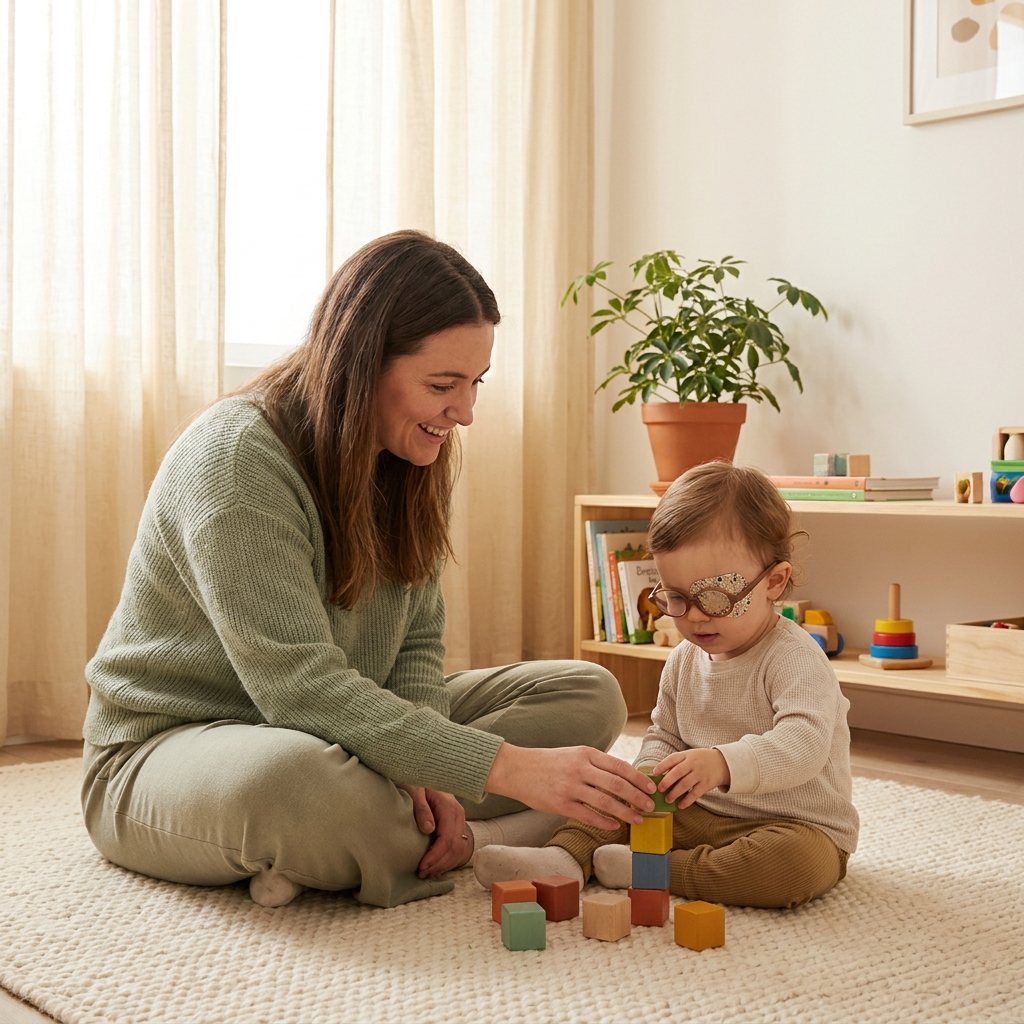
If someone has just told you your baby has cataracts, you are probably somewhere between frightened and overwhelmed, and you have almost certainly been handed more information than anyone can absorb in one sitting.
Here is the part that matters most: congenital cataracts are treatable, and the outcome depends heavily on acting early. Children treated promptly and supported consistently often go on to have good functional vision.
The rest of this guide explains what’s happening, what treatment involves, and what the years afterward tend to look like. Take it in pieces if you need to.
For the wider picture of cataracts at any age, see our guide to cataracts and low vision.
What Congenital Cataracts Are
A cataract is a clouding of the eye’s natural lens. In adults it develops over decades. In children it may be present at birth or appear in the first months or years.
It’s uncommon — roughly 3 in 10,000 children, though published estimates vary.
The crucial difference from adult cataracts is developmental. An adult who develops a cataract already has a fully wired visual system. The cataract blocks vision the brain already knows how to use, and removing it restores access to that ability.
An infant’s visual system is still being built, and it builds itself using the images the eye delivers. A cataract blocking those images doesn’t just obscure sight — it interrupts the wiring of vision itself. That’s why timing matters so much more in children, and why treatment moves faster than it would for an adult.
One eye or both. Cataracts affecting one eye (unilateral) and both (bilateral) behave differently. With one eye affected, the brain tends to favor the clear eye and suppress the other, which makes amblyopia a larger risk. With both affected, development is slower overall but more symmetrical.
Causes include genetic factors, metabolic conditions, infections during pregnancy, and injury. In a substantial number of cases no cause is ever identified, and that isn’t a failure of investigation. Because some cataracts signal a wider health condition, your child may be referred for additional testing — that’s routine thoroughness rather than a sign of bad news.
If a genetic cause is found or suspected, genetic counseling is usually offered and is worth taking up, particularly if you’re considering more children.
How They’re Found
The red reflex test is the main screening tool, done on newborns. A light shone into the eyes should produce an even reddish glow from both. A cataract disrupts it.
What parents sometimes notice first:
- A white, grey, or cloudy appearance in the pupil, often most visible in photographs taken with a flash
- Eyes that don’t seem to follow faces or objects by the expected age
- Eyes that drift, wander, or don’t move together
- Rapid, repetitive eye movements
- A baby who seems untroubled by bright light when you’d expect a reaction
If you’ve noticed something, say so, and say it again if you’re not satisfied. Parents are often right about their own children, and a concern raised twice is not being difficult. Ask specifically for a red reflex check and a referral to a pediatric ophthalmologist if the concern persists.
Surgery and What Follows
Treatment for a visually significant cataract is surgical, and it usually happens earlier than families expect.
Timing is driven by development. For dense cataracts, surgery in the first weeks to few months is common, because the window in which the visual system is most adaptable is early and finite.
The procedure removes the clouded lens. In older children an artificial lens is often implanted at the same time. In very young infants surgeons frequently leave the eye without an implant and correct vision with a contact lens or glasses instead, because the eye is still growing rapidly and its final focusing needs can’t yet be predicted. An implant may be placed later.
Both approaches are well established. Which one is recommended depends on your child’s age, whether one or both eyes are affected, and your surgeon’s judgment.
The surgery is the short part. What follows is the long part, and it’s where the outcome is really determined.
Amblyopia: The Part That Needs the Most From You
Removing the cataract gives the eye a clear image. It does not automatically teach the brain to use it.
Amblyopia — sometimes called lazy eye — is what happens when the brain, having received poor input from an eye during development, learns to ignore it. It’s the single biggest risk to your child’s long-term vision, and it’s larger when only one eye was affected.
Treatment usually means patching the stronger eye for prescribed periods, forcing the brain to use the weaker one and build those connections. Sometimes drops that temporarily blur the stronger eye are used instead.
This is hard, and it’s worth knowing that in advance. Young children object to having their good eye covered, often loudly. Parents describe the patching years as more demanding than the surgery by a wide margin.
A few things that help:
- Patch at a consistent time each day so it becomes routine rather than a negotiation
- Pair it with something absorbing — a favorite show, a tablet game, or focused play
- Use a reward chart for older toddlers and children
- Tell nursery and school what you’re doing and why, so they reinforce it
- Talk to your ophthalmology team if it isn’t working. Schedules can often be adjusted, and a plan you can actually follow beats an ideal one you can’t
The consistency genuinely matters. This is the part of treatment most directly within your control, and the part with the clearest effect on the result.
The Longer View
Children treated for congenital cataracts stay under review for years — often into adulthood.
Glasses or contact lenses are usually needed long-term, particularly if no implant was placed. Infants wear contact lenses more successfully than most parents imagine, and your team will teach you the handling.
Glaucoma is a recognized long-term risk after infant cataract surgery, which is one of the main reasons follow-up continues for so long. It’s monitored precisely so it can be caught early.
School years may involve large print, good lighting, preferential seating, and sometimes classroom technology. Children with a vision condition are frequently eligible for formal educational support, and it’s worth asking about early rather than waiting for difficulties to appear.
Outcomes vary, and honesty serves you better than reassurance here. Many children achieve good functional vision. Some have reduced vision in one or both eyes despite everything being done well. Either way, children adapt remarkably, and reduced vision is compatible with a full, independent life.
Low vision support isn’t only for later. If your child’s vision remains limited, magnification, lighting, contrast, and the right classroom setup help from early on. Families often wait for a threshold that never formally arrives.
New England Low Vision and Blindness works with families across New England, providing functional vision assessment and training services for children and the adults supporting them.
Looking After Yourself Through It
This section isn’t in most clinical guides, and it should be.
Parents of children treated for congenital cataracts describe a specific kind of exhaustion — not from the surgery, but from the years of appointments, patching battles, contact lens handling, and the constant low-level worry about whether you’re doing enough.
A few things worth hearing:
The patching resistance is not a reflection on you. Every family finds it hard. Children who fight it are behaving completely normally, and a child who resists is not a child whose treatment is failing.
Ask for the plan in writing. Appointments move quickly and involve a lot of detail. Requesting a written summary, or recording the conversation, is reasonable and most teams are happy to oblige.
Find other families. Parent groups for childhood vision conditions exist, and families consistently describe them as the thing that helped most. Talking to someone two years further along answers questions no clinician can.
You don’t have to be the expert on everything. Your job is consistency with the daily routine and honest reporting at appointments. The rest belongs to the team.
If you’re struggling, say so — to your child’s team or your own doctor. Caring for a child with a medical condition is genuinely demanding, and it is not a weakness to need support for it.
Frequently Asked Questions
What causes congenital cataracts?
Causes include genetic factors, metabolic conditions, infections during pregnancy, and injury. In many cases no cause is identified. Because cataracts can occasionally signal a broader health condition, additional testing is often arranged as a routine precaution.
How soon does my baby need surgery?
For a cataract significantly blocking vision, surgery is often recommended within the first weeks to months. The reason is developmental — the visual system builds itself using the images it receives, and that window is most adaptable early. Your pediatric ophthalmologist will advise on your child’s situation.
Will my child need glasses or contact lenses after surgery?
Usually yes, especially if no artificial lens was implanted. Infants often wear contact lenses successfully, and your team will teach you how to handle them. An implant may be placed later as the eye finishes growing.
What is patching, and does it really matter?
Patching covers the stronger eye for set periods so the brain is forced to use the weaker one and build those connections. It matters a great deal — it’s the main treatment for amblyopia and the part of the process most within a family’s control.
Will my child have normal vision after treatment?
Many children achieve good functional vision, particularly with early treatment and consistent follow-up. Some have reduced vision in one or both eyes despite excellent care. Outcomes depend on how early treatment began, whether one or both eyes were affected, and how amblyopia treatment went.
What signs should I look for in my baby’s eyes?
A white or cloudy appearance in the pupil, especially in flash photographs; eyes that don’t follow faces or objects by the expected age; eyes that drift or don’t move together; or rapid repetitive eye movements. Raise any of these with your pediatrician and ask for a red reflex check.
Talk With Someone Who Understands Vision Loss
You don’t have to sort this out on your own. New England Low Vision and Blindness works with families across New England to support children with vision conditions at home and at school.
Schedule No-Obligation Consultation or call us at 888-211-6933.