Driving with Low Vision: Complete Guide
For most Americans, driving is not just transportation. It is independence. It is the ability to get to a medical appointment without arranging a ride, to pick up grandchildren from school, to run an errand on your own schedule. When a vision diagnosis enters the picture, one of the first fears many people face is losing that freedom. If you are living with low vision and wondering whether you can still drive, the answer may surprise you.
Many people with low vision drive safely and legally every day, often with the support of specialized devices, professional training, and careful evaluation. Driving with low vision is not a simple yes or no. It depends on your specific condition, your state’s regulations, and whether you are a good candidate for the adaptive programs that make continued driving possible.
This guide covers the full picture: the legal vision standards states use for licensure, what a professional driving evaluation involves, the adaptive devices available (bioptic telescopes and beyond), the training process from first appointment to licensed driver, how to manage glare and light sensitivity on the road, financial assistance options, and an honest discussion of when driving may no longer be the safest choice. Whether you are newly diagnosed or have been managing a vision condition for years, you will leave with specific, accurate information to guide your next steps.
At New England Low Vision and Blindness, our specialists work with individuals across New England navigating exactly this question. Our comprehensive low vision services include driving-focused evaluation, and we are here to help you understand what is possible for your situation.
Can You Drive with Low Vision?
Yes, many people with low vision can drive. That is the direct answer, and it is one that surprises a significant number of people who assume a low vision diagnosis automatically ends their driving life. It does not.
In the driving context, low vision generally refers to visual acuity below 20/40 (the standard threshold for unrestricted licensure in most states) but above 20/200 (the legal blindness threshold). Within that range, more than 45 states permit driving with the use of bioptic telescopes and other adaptive devices. If your acuity falls between approximately 20/60 and 20/200 in your better eye, you may be a candidate for a bioptic driving program, depending on your state’s specific rules and your overall visual profile.
The critical word is evaluation. Self-assessment is not a reliable substitute. Research consistently shows that people with progressive vision loss adapt their behavior gradually, making it genuinely difficult to accurately judge their own driving safety over time. Your perception of how well you see while driving may not match what a clinical evaluation reveals about your contrast sensitivity, peripheral vision, glare recovery, and reaction time. All of these factors matter on the road, and all require objective professional measurement.
Even if you are not currently eligible for unrestricted driving, that does not mean the door is permanently closed. Vision rehabilitation, updated prescriptions, and adaptive training have helped many individuals with low vision return to driving safely. The starting point is always a professional evaluation, not a self-assessment or a conversation with family members who are not specialists.
If you have questions about your own candidacy, our low vision evaluation program is a natural first step. We can help you understand where you stand before you commit to anything further.
Vision Requirements for Driving by State
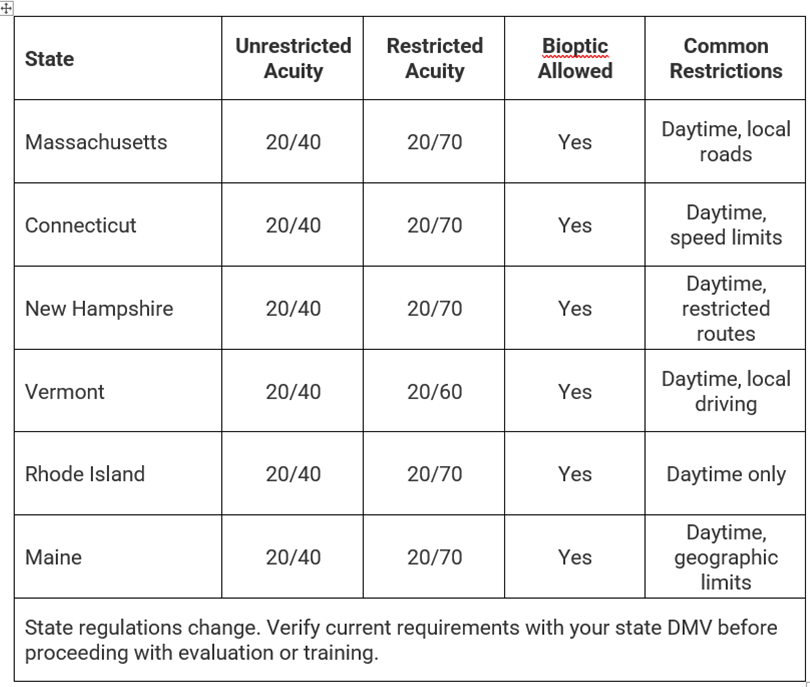
Every state sets its own vision standards for driver licensure, and the variation is significant. Understanding the framework your state uses is essential context before pursuing any evaluation or program.
Most states operate on a tiered system:
- 20/40 or better (with correction): Unrestricted license in the vast majority of states
- 20/50 to 20/70: Restricted license available in most states, with conditions such as daytime-only driving, speed limits, or geographic restrictions
- 20/70 to 20/200 (through bioptic telescope): Eligible in 45 or more states after completing an approved bioptic driving program
- Below 20/200: Not eligible for standard licensure in any state
Peripheral vision requirements apply separately. Most states require a minimum horizontal visual field of 70 to 140 degrees. Conditions that reduce peripheral vision, such as retinitis pigmentosa, glaucoma, or hemianopia, may affect eligibility regardless of central acuity. Your evaluating specialist will assess your complete visual profile, not acuity alone.
The table below covers a sample of key states. Because regulations change, always verify current requirements directly with your state’s DMV before proceeding.
Low Vision Driving Assessment: What to Expect
A low vision driving assessment is fundamentally different from the vision check at a standard DMV test. It is a comprehensive clinical evaluation designed to measure all the visual functions relevant to safe driving, not just the smallest letter you can read on a chart.
Who performs it: Evaluations are conducted by a certified low vision specialist, often in collaboration with an occupational therapist credentialed in driver rehabilitation. In some programs, a Certified Driving Rehabilitation Specialist (CDRS) is also involved from the beginning. Your general optometrist or ophthalmologist may refer you to one of these specialists, or you can seek a referral independently.
What is tested:
- Visual acuity with standard correction and with any adaptive device under consideration
- Contrast sensitivity, which determines how well you distinguish objects from their background in varying light conditions
- Visual field in all directions, with specific attention to peripheral areas
- Glare recovery, meaning how quickly your vision returns to normal after exposure to a bright light source
- Color vision relevant to traffic signal recognition
Reaction time and visual-cognitive processing speed
Many programs also include a behind-the-wheel assessment conducted in a controlled environment with a trained instructor. Observing how your visual function operates in an actual driving context often reveals things that clinical testing alone cannot.
Timeline from evaluation to clearance typically ranges from 4 to 12 weeks. This window accounts for device fitting, stationary training, and the required behind-the-wheel hours before a state license test. It is a structured process, not a quick fix. Each step builds the skills that make bioptic driving genuinely safe.
Cost ranges: Clinical low vision evaluation typically runs $200 to $500. Bioptic telescopes, if prescribed, cost $1,500 to $3,500 depending on power and design. Full driving rehabilitation training programs typically run $2,000 to $5,000. Combined, the total investment for an evaluation-to-license process ranges from roughly $3,500 to $8,500. Many individuals qualify for state vocational rehabilitation (VR) funding that covers most or all of these costs, which we cover in detail in the resources section below.
If you are ready to understand your options honestly, the right first move is a conversation with a specialist. Schedule a free consultation with NELVB to talk through your situation and learn what a full evaluation would involve for you.
Adaptive Devices for Low Vision Driving
Bioptic telescopes receive most of the attention in low vision driving discussions, and for good reason. But they are not the only tool available, and not everyone needs the same solution. Here is a complete picture of the adaptive devices used for driving with low vision, what each one addresses, and when each is most appropriate.
Bioptic Telescopes
A bioptic telescope is a small optical telescope, typically 2x to 4x magnification, mounted in the upper portion of an eyeglass lens. The lens itself is called the carrier lens. It provides your widest usable field of view for the vast majority of driving. The telescope sits just above your natural line of sight, and you dip your gaze slightly downward to glance through it when you need to read a sign, identify a distant traffic signal, or spot a hazard at range.
This is targeted use, not constant magnification. Experienced bioptic drivers use the telescope for approximately 5 to 10 percent of total driving time. The rest of the time they rely on their carrier lens and natural peripheral vision, much as any driver occasionally glances at instruments and mirrors.
Bioptic driving works best for people with central vision loss who retain functional peripheral vision. Macular degeneration and Stargardt disease are the most common qualifying conditions. For people whose peripheral vision is also significantly reduced, bioptic driving may not be appropriate. Your evaluating specialist will determine candidacy based on your complete visual profile, not the diagnosis alone.
Anti-Glare and Night Driving Glasses
For many low vision drivers, glare is the primary safety issue, not reduced acuity. Specialized lenses can significantly improve driving comfort and visibility in specific conditions.
Yellow and amber-tinted lenses filter short-wavelength blue light and improve contrast in overcast, hazy, or low-light conditions. Many low vision drivers find these dramatically improve their perception of road edges and lane markings on cloudy days. Anti-reflective coatings reduce scatter from oncoming headlights. Polarized lenses cut reflected glare from wet roads, water, and other horizontal surfaces.
These lenses do not improve acuity, and they are not appropriate in all situations. Dark-tinted lenses at night actually reduce total light transmission and can worsen visibility for some individuals. The right choice depends on your condition, driving environment, and visual profile. A low vision specialist can recommend what is appropriate for your specific situation.
Prism Lenses and Field Expanders
Where bioptic telescopes address central vision loss, prism lenses are designed for people with peripheral vision loss. Conditions like hemianopia (loss of half the visual field), retinitis pigmentosa, and advanced glaucoma can reduce the horizontal visual field to a degree that standard driving becomes unsafe.
Prism lenses work by optically shifting images from outside your functional visual field into the area where you can see. This does not restore the missing field. Rather, it provides an alert that something exists there, prompting you to turn your head for a direct look. Field expanders operate on a similar principle, using small wide-angle optical elements at the edge of the lens to expand peripheral awareness.
Both devices require specific fitting and training to use safely. Incorrect use can create disorienting visual effects. Whether prism lenses make driving viable depends on the extent of field loss and the adequacy of the remaining functional field. Professional evaluation is essential before assuming either solution is appropriate.
Vehicle Modifications
Beyond optical devices, several vehicle adaptations can support safer driving for people with low vision:
- Wide-angle or panoramic exterior mirrors that expand the rear and side visual areas without requiring head movement
- Backup cameras and parking sensors to compensate for reduced peripheral awareness when reversing
- GPS navigation with voice guidance, which reduces the frequency of sign-reading and allows more visual attention on the driving environment
- Dashboard dimming to minimize instrument panel glare at night without affecting road visibility
- Anti-glare windshield treatments and properly positioned visors to reduce sun and headlight scatter
These modifications complement optical devices rather than replacing proper evaluation and training. Our assistive technology specialists can help you identify which tools are most appropriate for your specific situation.
The Bioptic Driving Training Process
One of the most common questions we hear is how the bioptic driving process actually works in practice. Understanding the full timeline, from first evaluation to licensed driver, helps you approach it with realistic expectations. This is a structured rehabilitation process, not simply adjusting to a new pair of glasses.
Step 1: Low Vision Evaluation and Device Fitting (1 to 4 visits, 2 to 4 weeks)
Your low vision specialist conducts a comprehensive assessment to determine whether bioptic driving is appropriate for your condition and visual profile. Candidacy depends on more than acuity. Available peripheral vision, contrast sensitivity, cognitive function, and the specific nature of your vision condition all factor in. If you are a good candidate, the specialist prescribes a bioptic telescope calibrated to your specific needs. Power, design, frame fit, and lens alignment are all custom to you. Initial orientation to the device begins in the clinical setting before any driving.
Step 2: Stationary Training (2 to 4 weeks)
Before you get behind the wheel, you practice the foundational skill of spotting. This means locating targets quickly through the telescope, transitioning fluidly between the carrier lens view and the telescope view, and building the muscle memory that allows brief, accurate glances without losing broader situational awareness. Stationary training happens in clinical and community settings. Think of it as the cognitive and motor rehearsal that must precede driving.
Step 3: Behind-the-Wheel Training with a CDRS (4 to 8 weeks, 10 to 20 hours)
A Certified Driving Rehabilitation Specialist guides you through progressively complex driving environments. Programs typically begin in a parking lot, advance to low-traffic residential streets, then to arterial roads, and eventually to highway driving if your state permits it and your skills support it. Sessions typically run one to two hours, two to three times per week. The CDRS evaluates your performance at each stage and adjusts the training accordingly before advancing.
Step 4: State Driving Test
Some states require a bioptic-specific road test with a specialist examiner. Others accept a standard road test taken with the bioptic in use. Upon passing, your license is issued with applicable restrictions, which typically include daytime-only driving, speed limits, and sometimes a geographic radius. Most states require annual or biennial renewal for bioptic drivers, including updated clinical vision testing.
Total timeline: From first evaluation to licensed driver, most candidates complete the process in 2 to 4 months
Managing Glare and Light Sensitivity on the Road
Ask any low vision driver what makes driving most difficult, and the answer is almost always the same: glare. Whether it is sun glare off a wet road, oncoming headlights at night, or the flat light of an overcast afternoon, light sensitivity is the most consistently reported driving challenge among people with low vision. Understanding why it happens and how to manage it can extend your safe driving life significantly.
Many conditions that cause low vision, including macular degeneration, cataracts, diabetic retinopathy, and corneal irregularities, also affect the eye’s ability to filter and adapt to light. This creates increased scatter within the eye that reduces contrast and detail precisely when bright or shifting light is present.
Daytime strategies:
- Polarized or amber-tinted lenses to cut reflected glare from road surfaces, water, and other vehicles
- Proper visor positioning to block direct sun without narrowing your visual field
- Route planning to avoid driving directly into the sun during low-angle morning and afternoon hours
- A clean windshield, because interior film buildup significantly amplifies sun glare
- Photochromic lenses that automatically adjust tint to ambient light levels throughout the day
Nighttime strategies:
- Anti-reflective coated lenses to reduce the starburst and scatter effect from oncoming headlights
- Reducing speed on unfamiliar routes to allow more decision time
- Focusing on the right edge of the road rather than looking directly into oncoming lights
- Sticking to familiar, well-lit routes at night until you have built confidence with the conditions
- Dashboard dimming to prevent instrument panel glare competing with road visibility
Conditions that generally warrant avoiding driving: The dawn and dusk transition periods consistently present the highest challenge for low vision drivers, when the sky carries bright ambient light but road surfaces have low contrast. Heavy rain and fog similarly compound glare and reduce visibility in ways that create disproportionate difficulty. Building personal awareness of your glare threshold and voluntarily choosing not to drive in those conditions is a safety practice, not a limitation.
When Driving May No Longer Be Safe
This is the section most guides avoid. We are not going to avoid it, because an honest guide to driving with low vision has to include a frank conversation about when driving is no longer the safest choice. Leaving this out does not serve anyone.
Vision conditions are progressive in many cases. What supports safe driving today may not support it in two or three years. Staying current with your vision status through regular clinical assessment and making driving decisions based on that assessment rather than habit, is how you protect yourself and everyone around you.
Warning signs that a formal driving evaluation is overdue:
- Near-misses or minor accidents that are new patterns, not isolated incidents
- Getting confused or disoriented on routes you have driven for years
- Difficulty reading traffic signs until you are very close to them
- Avoiding certain roads, times of day, or conditions you previously drove comfortably in
- Feeling significantly more anxious or fatigued after driving than you used to
- Family members or passengers expressing concern about your driving
- Difficulty accurately judging distances or the speeds of other vehicles
If any of these are present, a formal evaluation, not a self-assessment or a conversation with family, is the right response. A certified evaluator can determine whether your current visual function supports safe driving, whether adaptive devices or training could address the gap, or whether a voluntary transition away from driving is the safest path.
Stopping driving is not a failure. It is a safety decision that protects you and everyone on the road with you. At NELVB, we are committed to honest evaluation. Our job is not to tell you what you want to hear. It is to give you an accurate picture of your capabilities so you can make the best decision for yourself.
For those who do transition away from driving, NELVB also helps with what comes next. Between paratransit services, senior transportation programs, ride-share platforms, and community volunteer driver organizations, there are real paths to maintaining independence and quality of life without a car. Our team can help you identify what is available in your area throughout New England.
Financial Assistance and Resources
One of the most important and least publicized facts about bioptic driving programs is that state vocational rehabilitation may cover most or all of the cost. Here is what you need to know.
State Vocational Rehabilitation (VR) Programs: Every state funds a vocational rehabilitation program designed to help individuals with disabilities maintain employment and employment-related independence. If driving is necessary for your work or for the independence that supports your ability to work, VR funding may apply to low vision evaluation, bioptic device costs, and behind-the-wheel training. In many states, approved candidates have their entire program covered. Contact your state VR office early in the process, before you begin evaluation, because funding approval typically precedes service delivery.
Nonprofit Grants: Lions Club International, the Foundation Fighting Blindness, and various state-level commissions for the blind offer grants for assistive devices and rehabilitation programs. Eligibility criteria and award amounts vary. These are worth investigating when VR coverage does not fully apply or is unavailable.
Veterans: Veterans with service-connected or non-service-connected visual impairment may access VA low vision programs that cover clinical evaluation, device costs, and driving rehabilitation training at no out-of-pocket cost. VA blind rehabilitation services include bioptic-specific evaluation at select VA medical centers. Our team can help you navigate VA resources in New England.
Health Insurance: Standard health insurance rarely covers driver rehabilitation training, but many plans do cover a portion of the clinical low vision evaluation, particularly when ordered by your ophthalmologist. Always verify coverage before assuming you will pay out of pocket
Key Organizations to Know:
- Association for Driver Rehabilitation Specialists (ADED): Maintains a national directory of Certified Driving Rehabilitation Specialists searchable by state. Visit aded.net.
- Your state’s Commission for the Blind or Department of Vocational Rehabilitation: First call for funding eligibility determination.
- NELVB: We maintain current referral contacts for driving rehabilitation specialists, VR offices, and financial assistance programs across New England and are happy to connect you with the right people for your state.
Take the Next Step Toward Driving Independence
If you are living with low vision and worried about your driving future, the most important thing you can do right now is get an accurate picture of where you stand. Not based on fear, and not based on what you think you can or cannot see. Based on a professional evaluation by someone who specializes in exactly this question.
At New England Low Vision and Blindness, we offer free consultations to help you understand your options. Our specialists will discuss your vision condition, your driving concerns, and whether a full evaluation makes sense as a next step. There is no pressure. No obligation. Just honest, expert information so you can make your next decision with confidence.
A driving evaluation is not about limiting your options. It is about finding out what is genuinely possible, and then making it happen safely.
There is no commitment and no pressure. Just expert guidance toward solutions that match your real situation.
Schedule for your free consultation today!
Explore independent living resources
Learn about our training services
Discover why families trust NELVB
You can also learn more about our assistive technology and low vision products or explore the full range of NELVB products and services designed to support independence with vision loss.